EM Microelectronic EM9305 Bluetooth 5.4 Chip Combines Ultra-Low Power, Compact Packaging, and Flexible SoC or Companion Operation
Wearables, tracking devices, and wireless peripherals must balance battery capacity, PCB space, processing resources, and connectivity. For products built around an existing controller, adding Bluetooth without replacing the established platform can also be an important development advantage.
The EM Microelectronic EM9305 is an ultra-low-power Bluetooth 5.4 chip that can operate as a standalone SoC or as a companion IC alongside an existing MCU or ASIC. It integrates a 32-bit ARC processor, FPU/DSP resources, 512kB Flash, 64kB RAM, power management, and security features for compact connected products.
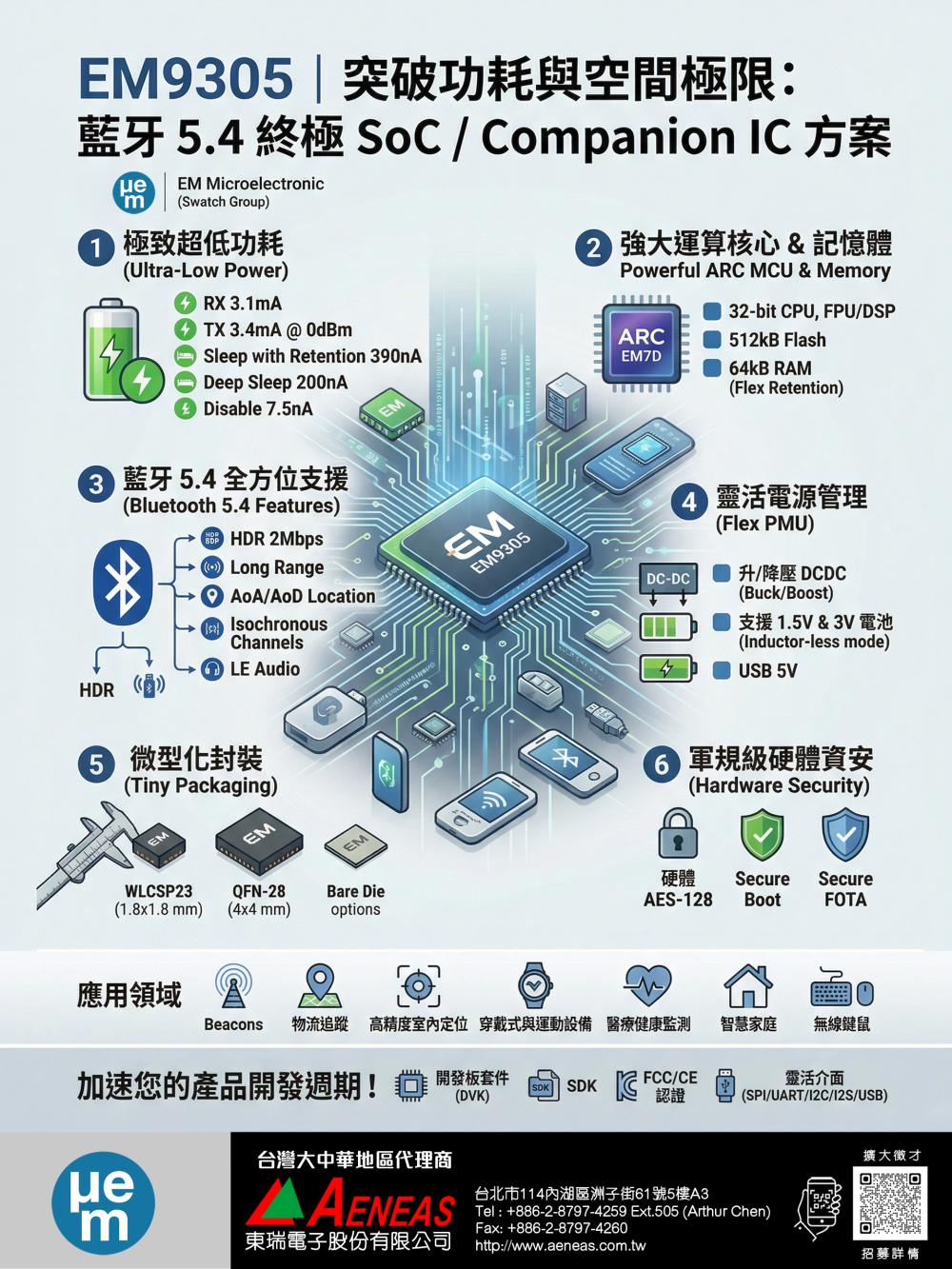
Low Power Across Active and Sleep Modes
The advertised current figures cover receiving, transmitting, retention sleep, deep sleep, and disable operation.
At a 3V supply, typical current is 3.1mA in RX, 3.4mA in TX at 0dBm, 390nA in Bluetooth LE sleep with a crystal oscillator and 4kB RAM retention, 200nA in deep sleep without RAM retention, and 7.5nA in disable mode.
These modes provide options for duty-cycled applications, but a sleep-current figure is not a complete battery-life estimate. Actual consumption must include radio activity, processing, external sensors, and the power circuit. Retaining the full 64kB RAM should not be assumed to deliver the same 390nA figure.
Integrated Processing and Memory
The ARC EM7D 32-bit core, floating-point and DSP resources, 512kB Flash, and 64kB RAM provide a platform for wireless protocols and application processing. Flexible retention allows memory needs to be considered alongside the power budget.
In SoC operation, the EM9305 executes application code directly. In companion operation, an existing MCU or ASIC remains responsible for the main application while the EM9305 adds Bluetooth connectivity. This gives teams a choice between greater integration and reuse of an established platform.
Bluetooth Features for Data, Direction Finding, and Audio Development
The advertisement highlights a 2Mbps mode, Long Range, AoA/AoD direction finding, isochronous channels, and LE Audio applications. These capabilities provide a basis for different connectivity requirements rather than a guarantee that every function is simultaneously available in every application configuration.
A 2Mbps PHY does not equal application throughput. Likewise, direction-finding support does not make the chip a complete positioning system: appropriate antennas, signal processing, and calibration remain necessary. The final feature set should be validated with the selected SDK, stack, and peer devices.
Flexible Power Management
he EM9305 supports power architectures based on 1.5V and 3V batteries, with integrated step-up/step-down DC/DC management and suitable inductor-less configurations. Removing the inductor requires the correct operating configuration; it is not a universal option for every supply condition.
Package-specific clarification: the manufacturer datasheet limits the USB interface and direct 5V USB supply capability to QFN and bare-die versions. These functions should not be assumed to be available in the WLCSP23 package.
Small Packages for Space-Constrained Products
Available options include 1.8 × 1.8mm WLCSP23, 4 × 4mm QFN-28, and bare die. Package selection should consider assembly capability and interface needs as well as size.
The complete wireless design must still accommodate the antenna, matching components, clocking, decoupling, and power circuitry. The chip footprint alone does not represent the area of a finished Bluetooth module.
Security and Development Support
The advertised security features include hardware AES-128, Secure Boot, and Secure FOTA. DVK and SDK support, together with SPI, UART, I²C, and I²S interfaces, provide resources for application development and peripheral integration. USB use remains package-dependent.
The advertisement does not provide evidence establishing automotive qualification. Hardware security should therefore not be interpreted as an automotive-grade certification. FCC/CE information also needs to be scoped correctly: manufacturer design support and certification of the EMREF9305QFN reference module do not automatically establish certification of a custom end product.
Applications from Beacons to Wireless Peripherals
Target applications shown in the advertisement include beacons, logistics tracking, indoor positioning, wearables, sports equipment, healthcare monitoring, smart homes, and wireless mice and keyboards.
A practical development process is to validate connectivity and application behavior on the development platform, then refine power, antenna, packaging, and firmware-update design. Complete-system measurements establish the achievable range, average current, interoperability, and maintenance behavior.